When Drive-Thru Tech Fails, So Does Your Data
Card readers fail mid-transaction. Employees use workarounds to hit metrics. Drive-thru timers get gamed. When drive-thru tech breaks, how operational data becomes fiction.

.avif)
The drive-thru has been central to the quick-service restaurant model since the 1940s and 1950s, when carhops gave way to intercom systems and the format found its footing as a reliable, high-volume channel for getting food to customers fast. Decades later, it still generates 60–70% of sales for many QSR brands. It's also where technology fails most often.
The reason failures hit hardest here is structural. Cars enter in order, transactions move forward in that same order, and once the line forms, there is no practical way to resequence it. When a payment terminal freezes or a POS drops offline, the delay spreads backward through every car in the lane.
The Breaks Come Often
Canopy’s Fast Food Fault Lines report found that 72% of drive-thru employees regularly encounter technology problems and 19% deal with them every day. The most common failures include faulty card readers (38%), POS systems going offline (31%), and timers that miscount or miss cars entirely (28%).
Nearly half of drive-thru employees (49%) use workarounds at least once a week to keep orders moving, and 54% have seen a customer abandon an order because of a technology problem.
Experienced employees know how to solve these problems. They know which systems to restart, which steps to skip, and how to keep a car moving when devices aren't working. That knowledge keeps the line alive. However, an experienced employee’s know-how also keeps the cost of tech problems hidden, which means those problems fail to be addressed and solved once and for all.
The Parallel System Inside the Lane
Let’s take a specific example: the timer. Drive-thru timers are supposed to measure how long service takes. In practice, employees have learned to game the system, which hides problems. In one Reddit thread, a Burger King customer asked why employees sometimes ask them to back up before reaching the window. An employee explained: "If you back up it resets your time so a faster time will go through, if you wait in the middle it deletes your car so it's like you never existed. They ask you this because you took too long to order."

While the timer records a better number, the customer's wait time doesn't change.
Other employees describe more physical approaches. One outlined a technique called "clipping" the car: "They are gaming the window time. I've seen it done in so many different ways. When I first started we did what we call 'clipping' the car. We took a paperclip and bent it into a 'C' shape and would put it in holes on the CPU it would pull the car to the window and then we could release it at like 15 seconds." Though it’s not quite clear how this “clipping” practice technically worked, the result was better metrics for managers.

Employees will game metrics, whether at Burger King or anywhere else. This is a matter of incentives. Consider how a former Wendy's assistant manager described what happens when times slip: “We got in supreme sh*t if our timer was over 120 seconds, it didn't matter what time of day or how big the orders were, or how short staffed we were.”
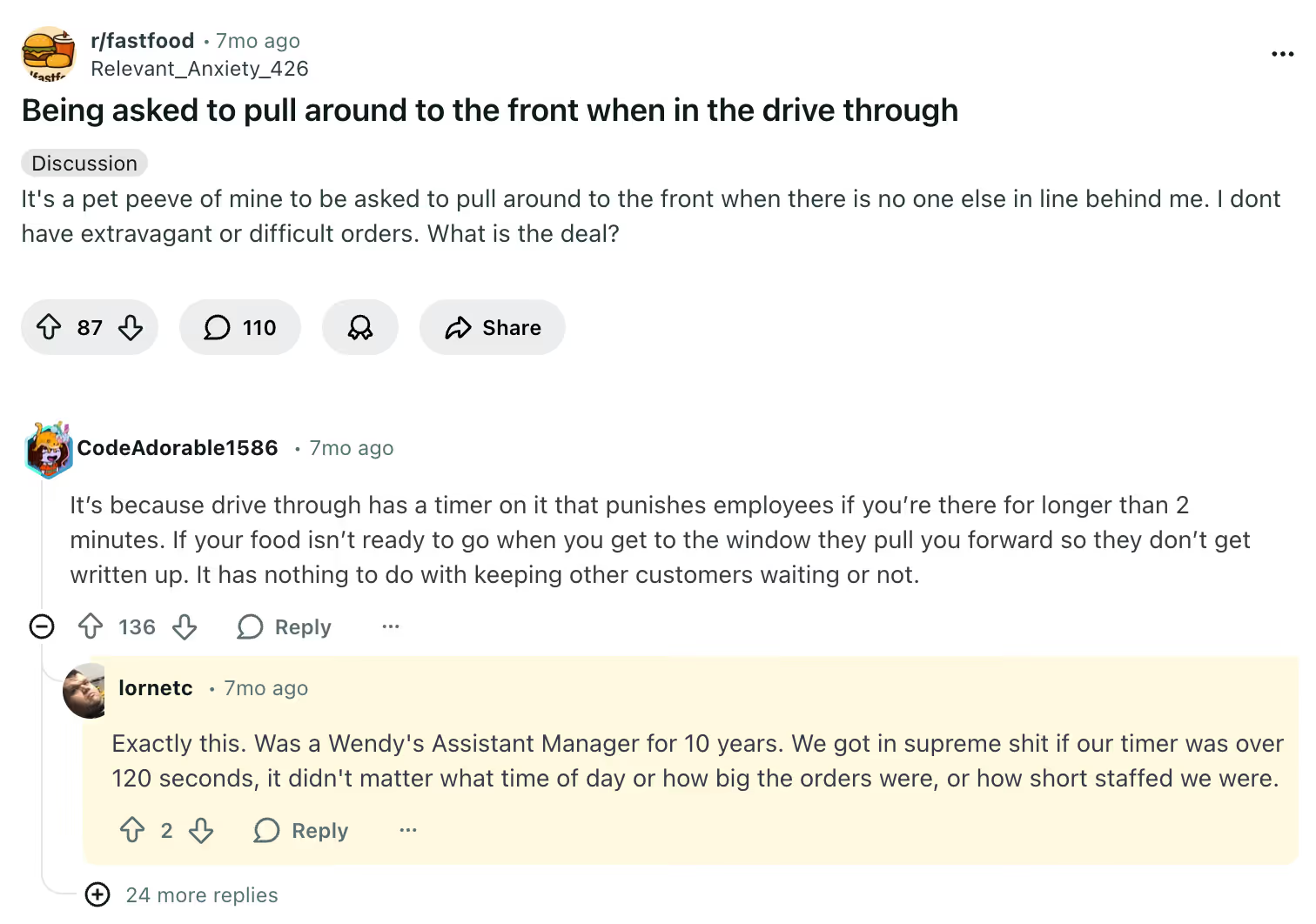
Pressure on employees to meet certain metrics (or else) leads employees to find ways to hit those metrics. The result is numbers that leadership interprets as both accurate and healthy. But reality in the restaurant is less clear-cut.
Get Fast Food Fault Lines
Access the 2026 Restaurant Tech Report instantly, and find out how to run a more reliable restaurant.
Get Fast Food Fault Lines
Access the 2026 Restaurant Tech Report instantly, and find out how to run a more reliable restaurant.
Will AI in the Drive-thru Solve Employee Problems?
Wendy's, White Castle, and Taco Bell are among a growing list of QSRs deploying voice AI to make their drive-thrus run more smoothly, though the underlying infrastructure stays vulnerable to the same failures.
AI-powered drive-thrus still depend on the same payment terminals, POS systems, and sensors that fail regularly, and they still require human intervention when things go wrong. When an AI system crashes mid-transaction, the customer is left waiting with no next step.
In other words, the same data issues apply. AI systems learn from and respond to the data generated by the drive-thru. If that data has been shaped by timer resets, manually entered orders, and sensor workarounds, the AI is working from a baseline built on those adjustments. The system ends up calibrated to what the data records rather than what happens in the lane.
Additionally, AI, like employees, must be told what metrics are important. How AI achieves those metrics may lead to unintended consequences. Whatever the case, solving this problem requires restaurants to find ways to get more data and from different perspectives. Here, having a way to monitor endpoint devices more holistically, rather than relying on simpler metrics that are used as proxies of reality, can lead to smarter decisions and better service optimization.
[[Remote monitoring and management]] designed to connect into all devices on location, from timers to signage to POS systems, cameras, and more, can be configured so as to create more accurate [[KPIs]].
What Reliable Systems Actually Change
QSRs have invested heavily in drive-thru technology precisely because the data it generates informs how they run their business. If that data reflects workarounds rather than actual performance, those decisions are built on the wrong foundation.
When drive-thru systems hold up consistently, workarounds decline, and the data starts to reflect what's happening in the lane. Operators can see where bottlenecks form, which locations are struggling, and whether service times are improving or being managed around.
Download the Fast Food Fault Lines report for the full findings.



.avif)