The 2025 Restaurant Tech Report: Fast-Food Friction
New survey reveals 80% of customers face kiosk problems and 76% experience payment failures at QSRs. See which brands lead in tech reliability.
Executive Summary
When they're hungry and short on time, customers choose quick-service restaurants (QSRs) that deliver consistent, easy experiences — whether it's a fast-food mainstay like McDonald's or a counter-service innovator like Chipotle.
The connected restaurant model aims to serves these expectations, integrating point-of-sale systems, self-service kiosks, mobile apps, and kitchen technology to create a seamless customer experience. When the technology supporting that model fails, customers notice.
To better understand what's working and what's causing friction, Canopy surveyed Americans about their experiences with three key QSR technologies: self-service kiosks, AI drive-thrus, and payment systems. The findings reveal both progress and problems — in particular, reliability gaps in the tools that directly impact loyalty.
Key Findings
- Technology Makes or Breaks Loyalty
4 out of 5 customers say technology influences where they eat. - Self-Service Kiosks Are Falling Short
The majority of customers (60%) use self-service tech at least occasionally, but 80% have run into problems. - AI Drive-Thrus Show Promise
Only 15% of customers have encountered AI drive-thru, and two-thirds of those users left satisfied by the experience. - Checkout Friction Persists
More than three-quarters of customers report payment technology issues; only 23% say it "always" works. - Leaders Are Emerging
McDonald's, Chick-fil-A, and Taco Bell lead in providing the best technology experiences.
Methodology
This report is based on a national survey conducted by Canopy in June 2025 to understand consumer perceptions of technology in QSR settings. The survey collected responses from 457 U.S. adults across a mix of geographies, age groups, and employment statuses.
{{toc:h2: Self-Service Kiosks Are Great... So Long as They Work}}
{{self-service-kiosks-desktop}}
{{self-service-kiosks-mobile}}
Customers turn to kiosks for speed and control. But when they fail, the whole experience falls apart.
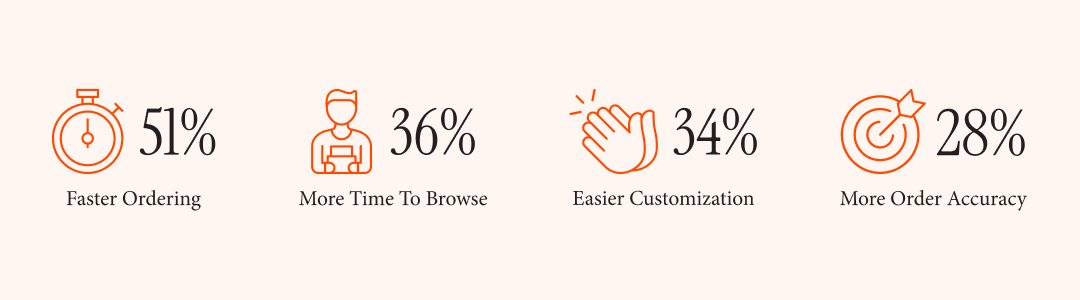
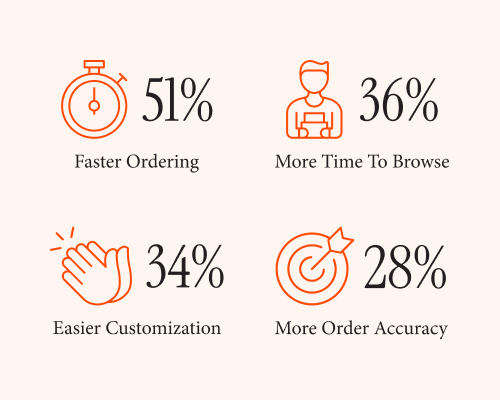
Self-service kiosks have become a fixture in the connected restaurant experience. More than 60% of customers use them at least occasionally, and 26% say they use them frequently. The appeal is clear: customers cite faster ordering, easier customization, more time to browse, and greater order accuracy as top reasons for using kiosks.
Still, using a kiosk can be frustrating. Only 20% of customers report that kiosks "always" work, 80% have experienced issues, most commonly with receipt printers, frozen screens, or kiosks that are out of order.
Top Reasons for Using Self-Service Kiosks
4 in 5 customers have experienced issues, most commonly with receipt printers, frozen screens, or kiosks that are out of order.
{{top-reasons-desktop}}
{{top-reasons-mobile}}
Building Customer Loyalty Through Reliability
Different groups' experiences with kiosks reveal both the stakes and the opportunity for QSRs to improve. The most loyal customers — those who visit QSRs three or more times per week — are also the most enthusiastic kiosk users. They rely on kiosks more often and report higher satisfaction.
When kiosks work reliably, they both improve the transaction and build customer loyalty.
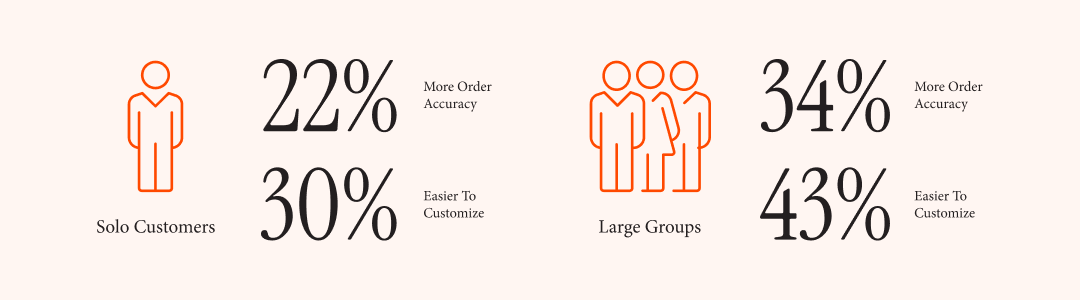
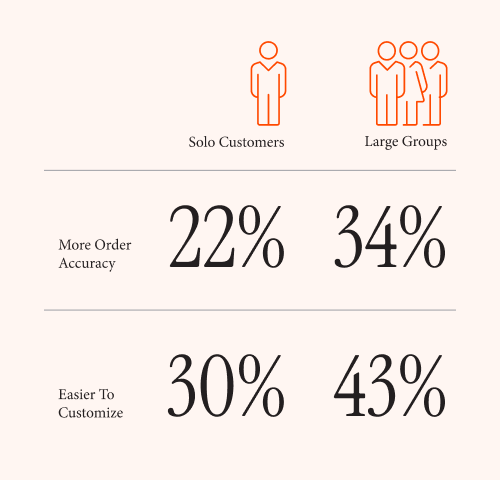
Top Reasons for Using Kiosks: Large Groups vs. Solo Customers
{{top-reasons-detail-desktop}}
{{top-reasons-detail-mobile}}
Group orders raise the stakes. Customers ordering for both adults and kids are more likely to choose kiosks for accuracy and easy customization, features that matter even more when orders are large or complex.
The Takeout Box: QSR customers with consistent, reliable kiosk experiences are more likely to return, increasing revenue with each order. Yet even minor malfunctions, like a receipt printer glitch, can sour the kiosk experience. As kiosk adoption grows, reliability must improve to keep pace.
{{toc:h2: AI Drive-Thrus Deliver for Early Users}}
{{ai-drive-thrus-desktop}}
{{ai-drive-thrus-mobile}}
Customers see potential in voice automation while accuracy and user experience design still need work.
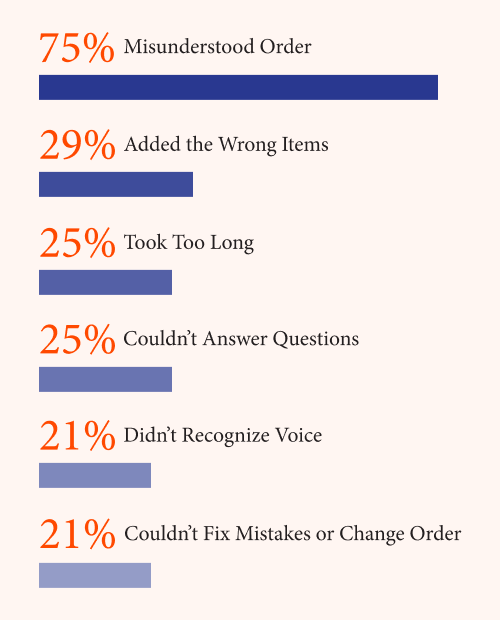
Across QSRs, only 15% of customers have encountered an AI drive-thru so far. Among those who have, two-thirds (66%) said the experience was as good or better than ordering from restaurant staff. That's a strong signal of potential.
However, AI-assisted voice-ordering still needs work. Of the customers who experienced issues, 75% said the AI misunderstood their order. Others reported that the process took too long. Finally, in open-ended feedback, customers pointed to a key frustration: upselling, which made the interaction feel robotic and inefficient.
So far, the message from early adopters is consistent. Customers are open to automation so long as it is accurate and intuitive. When AI feels quick and responsive — like ordering from a person — the experience works. The novelty wears off quickly when customers feel like they're stuck in a new-fangled tech experiment.
Top Issues With AI Drive-Thrus
{{top-issues-desktop}}
{{top-issues-mobile}}
AI Drive-Thrus: The Takeout Box
AI drive-thrus can meet or even exceed customer expectations when they work well. Small design missteps, like forced upsells or awkward voice flows, can quickly compromise the experience. Real-time device monitoring and automated troubleshooting and resolution can help QSRs catch and fix technology issues before they damage trust or disrupt the experience.
{{toc:h2: The Checkout Problem}}
{{checkout-problem-desktop}}
{{checkout-problem-mobile}}
No matter how they pay, customers keep running into issues at checkout. And it's costing brand loyalty.
Paying should be the smoothest part of the connected restaurant experience. So why is it the most frustrating for so many customers?
More than three-quarters (76%) of customers say they've run into issues with payment technology, and fewer than one in four say it always works.
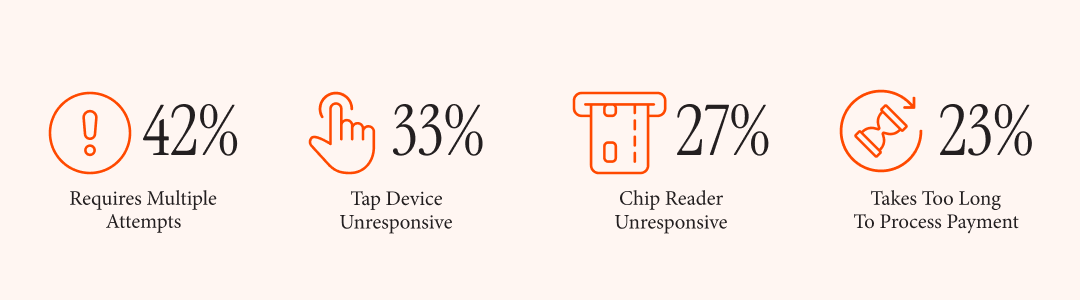
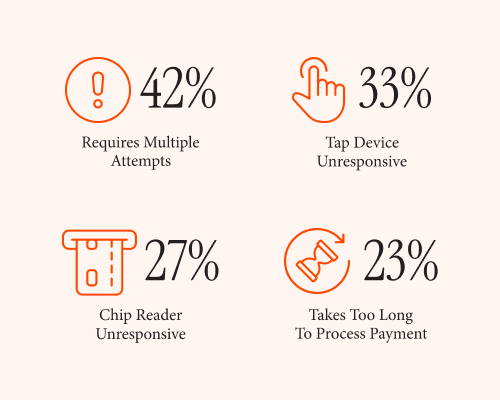
The most common complaints? Transactions that require multiple attempts, unresponsive tap devices, chip readers that fail, and slow payment processing. These issues all point to misbehaving point-of-sale (POS) systems.
Top Issues With Payment Technology
76% of customers say they've run into issues with payment technology.
{{top-issues-tech-desktop}}
{{top-issues-tech-mobile}}
Digital Wallets and Geographic Differences
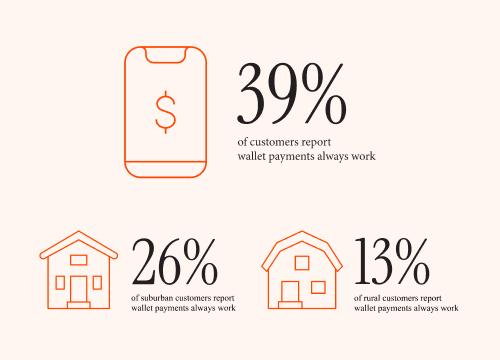
Geographic differences reveal another layer of friction. Suburban customers are twice as likely as rural customers to say payment technology works as expected, which suggests that remote locations may not be getting the same level of service or system support.
Digital wallets like Apple Pay and Google Pay ("Tap to pay") are becoming more popular, especially among frequent QSR customers. Nearly half (42%) of all customers use digital wallets at least occasionally, and those who do say speed is the top benefit.
Digital Wallet Payment Reliability by Location ("Always Works")
{{always-works-desktop}}
{{always-works-mobile}}
Frequent customers are also the heaviest digital wallet users.
Eighteen percent use digital wallets every time they can, and 39% say wallet payments always work. By comparison, just 24% of less-frequent customers say the same.
Payments: The Takeout Box
Quick service depends on quick payments. Checking out must work smoothly every time. For QSRs, delivering a fast and reliable experience requires real-time visibility into payment systems and the ability to resolve issues quickly before they disrupt the customer experience.
{{toc:h2: When Technology Drives Loyalty, Restaurants Win}}
{{when-tech-drives-desktop}}
{{when-tech-drives-mobile}}
Technology that works well goes unnoticed by customers — and that's the point.
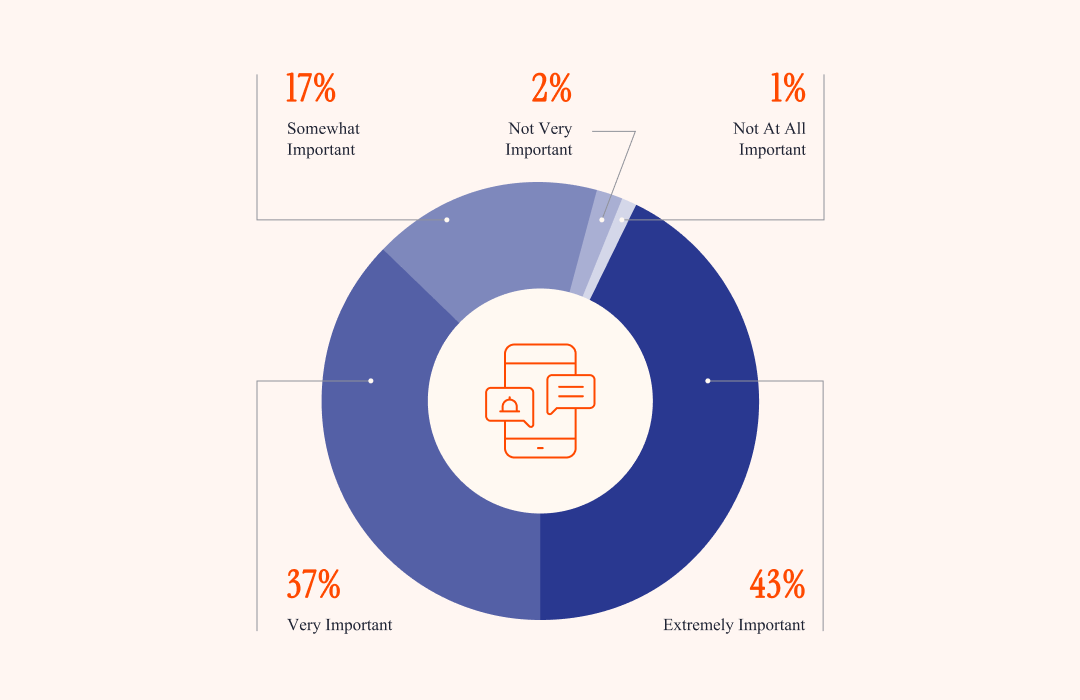
Customers choose QSRs for a consistent, reliable experience. So long as technology supports that kind of experience, restaurants will benefit. Indeed, 80% of those surveyed say technology influences where they choose to eat with more than two in five (43%) saying tech is extremely important.
How Important Is a Good Technology Experience When Choosing a QSR?
{{tech-experience-desktop}}
{{tech-experience-mobile}}
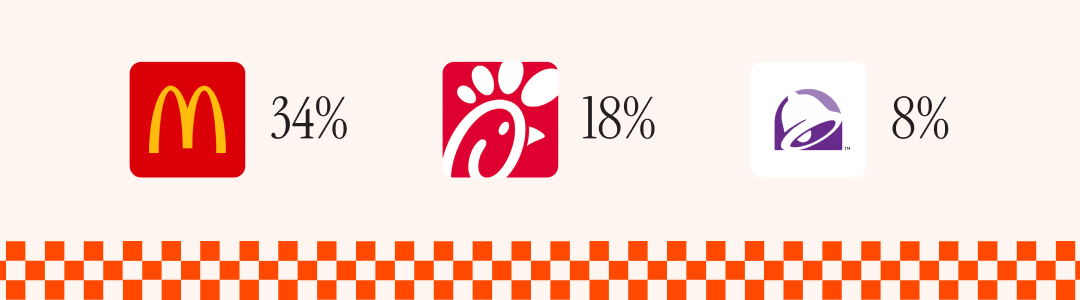
Top QSR Brands by Technology Experience
{{qsr-brands-desktop}}
{{qsr-brands-mobile}}
Certain brands are already setting the standard. For example, McDonald's, Chick-fil-A, and Taco Bell earned top marks from customers for the best overall technology experience. What sets these brands apart is consistency. When technology works reliably, it builds trust and brings customers back.
Kiosks: The Takeout Box
A kiosk that's out of order, a drive-thru that mishears, or a failed payment all bring friction to an experience that's supposed to be fast. Technology shortfalls and failures undermine the "quick-service" value proposition. In time, they push customers away rather than reward customers for trusting the restaurant, the franchise, and the brand with their business. Forward-thinking QSR brands already prioritize the end-to-end integration of technology into the connected restaurant experience. They know reliability is a core part of how they earn trust and build loyalty.
{{toc:h2: The Last Bite: Would You Like Action With That?}}
{{last-bite-desktop}}
{{last-bite-mobile}}
Restaurant technology plays a defining role in how customers experience quick-service brands. Whether things work smoothly or not, customers remember.
This survey shows that the biggest opportunity comes from making existing systems work every time. The entire connected restaurant ecosystem — from the network stack to self-service kiosks, kitchen display systems to order-ready boards and IP cameras — must perform consistently across locations. Because when restaurant tech fails, customers notice.
How Canopy Helps QSR Operations
Canopy allows QSR operators to centrally monitor and automate the remote management of their full connected restaurant stack, from front-of-house to back-of-house technologies. Our RMM platform gives technical support teams the tools to:
- Monitor the real-time health of every connected product and the underlying network infrastructure, from the kiosk to the Wi-Fi access point and kitchen display.
- Resolve remote device and endpoint issues before they disrupt service.
- Equip field teams with tools to manage deployed restaurant technology quickly, even automatically.
- Standardize performance across hundreds or thousands of locations, supporting connected products through onboarding, remote resolutions, and device lifecycle management.
Supporting a connected restaurant takes a forward-thinking approach. Canopy offers end-to-end visibility and management, for both the devices that power the QSR customer experience and the network stack that connects it all together.
When the entire connected restaurant works as expected, from kiosks to payment systems and more, everyone benefits, from customers to staff, driving consistency, customer satisfaction, lower costs, and higher revenues.
Like this report? Get the PDF in your inbox ⤵

Get Fast-Food Friction
Access the 2025 Restaurant Tech Report instantly to find out what quick-service restaurant goers want (and where brands fall short).

.jpg)
%20(1).avif)