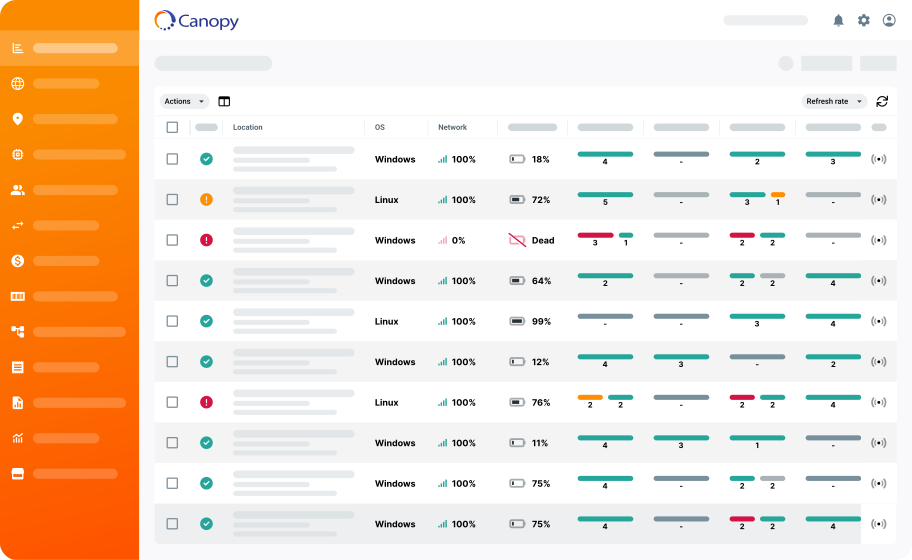
Raw device data
Agents • In beta
Ask your fleet a question
Canopy connects to every device you deploy, down to the card reader. Agents use rich connections to monitor device health, answer questions in plain language, and fix remote device problems across the locations you manage.






One fault, two clocks
Imagine a kiosk loses its network connection at 11:31AM. The resolution clock starts. With a traditional service desk, the network issue climbs three tiers and two handoffs over four hours all while remaining unresolved. By comparison, a Canopy AI agent catches the gateway reboot before anyone calls, renews the network connection under a pre-approved action, and logs everything for a technician to review later.
What previously took hours without resolution is done in nine minutes by Canopy AI.
Tiers exist to move information
A tiered service organization exists to react to information, like customer complaints. The system, which depends on people, availability, and trained know-how, pushes data until it reaches somebody who can act.
Agents work proactively and eliminate friction
AI agents work 24/7/365 based on predetermined objectives, activated to catch problems as soon as they occur if not before. Time-consuming ticket shuffling gets reduced if not eliminated entirely.
Why agents work here
An agent has nothing to reason about until a device can be read
One agent, whatever the device runs
Most connected products are made up of several devices in one box: a Windows host, an Android payment terminal, a Linux controller. Canopy reads each one and presents them as a holistic system at a single site. Then it monitors all the data you need, beyond the OS, from the card reader to the receipt printer to displays and more, reporting back key performance indicators about your fleet health.



Answer, notice, act
24/7/365 days agents noticing and acting
Let AI agents answer, notice and act across your fleet.
Request access now
Build an agent
Describe the job and the Assistant builds the agent
In the Agentic Console, click New agent and tell the Assistant what the agent should watch, what it should do about it, and what good looks like. It finds the blueprint that fits, drafts the agent, checks its connections, and waits for your approval before the agent is created.
Governance
Your team holds the controls
Approval by change type
Decide which changes an agent may make on its own and which ones wait for a person
Scoped to a group or a window
Hold an agent to one device class, one region, or one maintenance window.
Attributed and reversible
Every change is logged against the agent or technician who made it, with rollback available.
Handoff with the diagnosis written
When an agent reaches the end of what software can fix, the dispatch knows what it is walking into.
What customers say about Canopy

Canopy’s agentic AI is doing something we haven’t seen from other analytics or monitoring tools. During the MCP beta, we’ve been able to move from raw operational data to actionable insight much faster, helping us identify trends, investigate issues, and communicate value more clearly.
Natalie Castillo
Canopy Technical Platform Lead at Full Swing

We have thousands of devices deployed across very complex and different environments. We have Apple and Android devices, Linux controllers, payment terminals, printers, etc. We needed a single platform with central visibility and management of all the components inside our solution.
Clay Hardin
Product Manager at Revel Systems

Canopy has helped us really have a better understanding of the health of that kiosk and all the devices within it.
Robert Chiti
CEO at OpenTech Alliance

Accessing Canopy through the MCP interface is helping us rethink how we scale support. Our team can manage our fleet in less time and at lower costs, all while delivering better service.
Russ Middleton
Chief Operating Officer at RoveIQ